
In the chemical industry, achieving a stable mixture of water and oil is a constant technical challenge. Polysorbate 80 (also known as Tween 80 , Polyoxyethylsorbitan Oleate, or Polyoxyethylenylated Sorbitan Monooleate) is the ideal compound to solve this problem, making it an indispensable component in demanding industrial sectors such as food, cosmetics, and medicine.
If you’re wondering what Polysorbate 80 (Tween 80) is or why your production line requires it, this guide details its properties, applications, and safety profile.
What is Polysorbate 80?
It is a non-ionic surfactant and emulsifier that appears as a viscous, yellow to amber-colored liquid. Chemically, it is a synthetic compound derived from ethoxylated sorbitol and oleic acid.
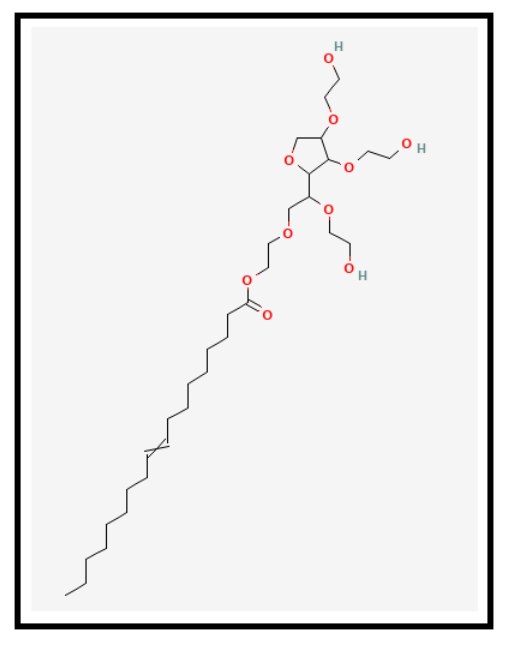
Image: Polysorbate 80 (Tween 80) molecule. Source: PubChem (2026)
Available at: https://pubchem.ncbi.nlm.nih.gov/compound/443315
Its molecular structure is amphiphilic (it has a part that is attracted to water and another that is attracted to fats). This allows it to reduce the surface tension between two immiscible liquid phases, facilitating the creation of stable oil-in-water (O/W) emulsions.
What is Tween 80?
It is the most well-known trade name for polysorbate 80. Both terms are used to refer to the same ingredient, so it is common to see them used interchangeably in technical data sheets, catalogs, and specialized articles.
In industry, this designation is very useful because it identifies an emulsifier widely used in liquid, semi-solid, and emulsified formulations. Its high compatibility with various systems makes it especially valuable in industrial and laboratory processes.
Polysorbate 80 – Safety Data Sheet
According to the Globally Harmonized System of Classification and Labelling of Chemicals (GHS) , the product is not classified as a hazardous substance. The critical guidelines from its safety data sheet and technical data sheet are:
- Hazards: It is not toxic, flammable, or corrosive. It does not require warning pictograms.
- Eye contact: May cause mild mechanical irritation. In case of splashing, rinse thoroughly with water for 15 minutes.
- Skin contact: It is not irritating or sensitizing under normal conditions of use.
- Spills: Being a dense, oily liquid, it makes floors slippery. Contain it with inert absorbents (sand or soil) and clean the area with hot water and detergent.
- Storage: Store in original airtight containers, in cool, dry areas protected from extreme temperatures or strong oxidizing agents.
What are the properties of Polysorbate 80?
The success of this compound lies in its excellent physicochemical profile, highlighting five fundamental properties:
High Hydrophilic-Lipophilic Balance (HLB)
It has a hydrophilic-lipophilic balance (HLB) of 15.0 . This means it is water-soluble. It is ideal for dispersing essential oils and oily active ingredients in aqueous matrices.
Exceptional chemical stability
Being a non-ionic surfactant , it has zero electrical charge. This prevents it from reacting negatively to the presence of salts (electrolytes) or moderate pH changes in the mixture.
High-efficiency solubilizing agent
It has the ability to encapsulate lipid molecules within microstructures called micelles, allowing dense oils to dissolve completely in water, keeping the mixture transparent.
Low vapor pressure and high thermal stability
This compound is distinguished by a flash point exceeding 149°C and a low vapor pressure. These technical attributes facilitate its integration into industrial processes requiring moderate heating, ensuring that the system maintains its functional integrity without the risk of harmful gas emissions.
Excellent synergistic compatibility
It works in harmony with other lipophilic emulsifiers. This combination allows formulators to adjust the HLB of the system to the exact value required by the final product to prevent phase separation.
What is polysorbate 80 used for?
The main uses are focused on unifying textures, stabilizing formulas and ensuring a homogeneous distribution of ingredients.
Polysorbate 80 in food
Identified under the international code E433 , this additive is fundamental in the food industry thanks to its remarkable technical performance even at minimal concentrations:
- Ice cream industry: Optimizes the structure of milk fats to encapsulate air, resulting in superior creaminess, greater resistance to melting, and inhibition of ice crystals.
- Margarines and dressings: It acts by stabilizing two-phase water and oil systems, ensuring product cohesion and preventing physical separation of its components within the container.
- Baking Sector: It works as an advanced dough conditioner, improving the volume of the piece and providing an exceptionally soft crumb.
To learn more about our range of specialized supplies for this sector, we invite you to consult our Food Category .
Polysorbate 80 in medicines
Within the clinical environment and advanced pharmacology, this component stands out as a fundamental pharmaceutical-grade excipient for the formulation of therapeutic solutions:
- Optimization of solubility: It exerts a technical action by encapsulating active ingredients of low hydrophilicity, promoting the manufacture of syrups of superior homogeneity and enhancing their bioavailability in the organic system.
- Injectable formulations and vaccines: Ensures the stability of the elements in total suspension, inhibiting the coalescence or agglomeration of microparticles in intravenous or intramuscular administration therapies.
- Ophthalmic solutions: It acts by regulating surface tension in the ocular tissue, which promotes prolonged retention of the drug without compromising the integrity of the mucosa or causing transient irritation.
To learn more about our selection of technical supplies for this sector, we invite you to explore our Pharmaceutical Industry Category .
Polysorbate 80 in cosmetics
It is highly valued for its gentleness and safe interaction with the skin:
- Bath oils: Allows body oils to transform into a milky emulsion upon contact with water, facilitating a clean rinse.
- Creams and lotions: Adds lightness to O/W textures, achieving rapid absorption without leaving a greasy feeling.
- Gels and shampoos: Helps incorporate pure fragrances, essential oils and fat-soluble vitamins into transparent aqueous bases.
Discover our full range of raw materials for this sector by visiting our Cosmetics Category .
Is Polysorbate 80 toxic?
The toxicity profile of this emulsifier is low, supported by international organizations such as the FDA and EFSA, which endorse its safe implementation in a wide range of mass consumer products.
In the context of laboratory evaluations, its median lethal dose by oral route (LD50) is above 34,500 mg/kg, a technical range that categorizes it as a virtually harmless substance.
Human metabolism processes this compound with high efficiency, dissociating oleic acid for conventional lipid assimilation, while the hydrophilic fraction is excreted through natural pathways without leaving cumulative residues in the body.
What are the side effects of Polysorbate 80?
Despite its recognition as a harmless additive, it is imperative to analyze potential adverse effects. These typically manifest in cases of acute hypersensitivity or when exposure exceeds recommended usage parameters.
- Skin barrier interaction: In users with reactive dermis or pre-existing dermatitis conditions, the application of formulas with atypical polysorbate densities could result in mild mechanical irritation, itching, or transient erythema in the treated area.
- Food grade intake: Due to its nature as a surfactant that modifies lipid tension, excessive consumption of this component could interfere with the integrity of the gastric mucus, causing a slight acceleration of intestinal transit or abdominal discomfort.
- Clinical and pharmaceutical context: Isolated cases of immune responses have been reported in patients receiving parenteral therapies with this excipient; however, such events are linked to the biological idiosyncrasy of the individual rather than to a toxic potential of Tween 80.
Polysorbate 80 – Contraindications
- Allergies: It should not be used in formulations intended for patients with a history of allergic reactions to polyethoxylated compounds.
- Severe intestinal compromise: In foods for patients with severe chronic inflammatory conditions (such as Crohn’s disease), dosage should be limited to avoid altering the permeability of the intestinal mucosa.
Final comments
Polysorbate 80 (Tween 80) remains one of the most reliable, cost-effective, and safe chemical tools in industry today. Its unparalleled ability to stabilize complex emulsions, enhance drug absorption, and refine the textures of food and cosmetics ensures its continued relevance in modern production chains.
If you are looking to optimize your production processes and require a reliable supplier to acquire this input with the guarantee of receiving a product that meets the strictest international standards of purity and quality, at SUMICHEM we are your strategic partner.
We invite you to contact our team of technical advisors to learn about availability, distribution formats, and receive a quote with the best market prices according to the volume required by your production plant.
Learn more about our history and quality standards in our About Us section .
Explore complementary solutions for your industry in our Catalog .
Ready to request a formal quote or personalized advice? Write to us directly through our Contact form or visit us on our website .